What RedNote is — and why Americans suddenly know it
Xiaohongshu — literally “Little Red Book” — is China's dominant lifestyle discovery app: part Instagram, part Pinterest, part Yelp, with a user base reported at roughly 300 million monthly actives. Users post “notes” (photo carousels or short videos) about restaurants, salons, products, and travel, and other users search those notes before deciding where to spend money.
In January 2025, the TikTok ban scare sent millions of American users flooding onto the app — the so-called “TikTok refugees” pushed it to the top of the U.S. App Store, and the English name RedNote stuck. For a local business, the moment matters less than the underlying fact: RedNote is where Chinese-speaking Americans decide where to eat, shop, and book — and almost no U.S. business is competing there yet.
Who is on RedNote in the U.S. — and why intent is so high
The core U.S. audience is the Chinese diaspora: students, young professionals, and families concentrated in neighborhoods like Flushing, Manhattan's Chinatown, Brooklyn's Sunset Park, and the Long Island suburbs. These are exactly the customers New York restaurants, salons, clinics, and service businesses want.
What makes RedNote marketing different from Instagram is search intent. Users type queries like “Flushing food” or “New York nail salon” in Chinese before they go out — and unlike a feed post, a note keeps ranking in RedNote search for months. A save on your note is not a vanity metric; it is a planned visit.
The New York numbers make this concrete: the metro area is home to one of the largest Chinese-speaking communities outside Asia, concentrated in a handful of neighborhoods. A note that ranks for “Flushing dentist” or “Sunset Park nails” addresses a dense, reachable market — customers who can walk through your door this same week.
The traffic-pool algorithm: how every note gets its shot
RedNote tests every note pool by pool. A new note enters the cold-start pool and is shown to roughly 200–500 people. If engagement clears the bar, it climbs to Pool II (5,000+ impressions), then Pool III (100,000+), and the strongest notes reach the viral pool at 1,000,000+ impressions. Engagement in the first hours decides everything.
This is the opposite of most platforms, where a small account is stuck with a small reach. On RedNote, a business with 50 followers can land a note in front of 100,000 people if the content earns it — every single note gets a fresh chance. That is why content quality beats account size, and why cadence matters: more notes, more lottery tickets, except the lottery is skill-based.
CES: how RedNote scores engagement
Whether a note climbs pools is governed by its CES (Community Engagement Score). The industry-circulated weights are worth memorizing — they should change what you post:
Read those weights again: a comment is worth four likes, and a follow is worth eight. So stop optimizing for likes. Design notes people save (menus, price lists, step-by-step guides) and notes people comment on (ask a question, run a poll, make a spicy pick). The platform evolves its exact formula constantly, but the direction — deep engagement over passive taps — has held for years.
- Like ×1 — the cheapest signal on the platform
- Save ×1 — but a save also predicts a real visit
- Comment ×4 — design your notes to start conversations
- Share ×4 — group-chat forwards are gold for restaurants
- Follow ×8 — the strongest single signal a note can earn
Content that works: 探店 store-visit notes and 种草 seeding posts
Two formats dominate local-business results. The 探店 (tan dian, “store visit”) note: a creator or customer visits, shoots photos, and writes an honest first-person review with a location tag. The 种草 (zhong cao, “seeding”) post: content built to make readers crave a specific dish, treatment, or product before they have ever seen your store.
Execution details decide the pool your note reaches. The cover image and title hook determine the click in the first three seconds. Keywords in the title, body, and tags determine whether the note ranks in RedNote search for months. By vertical: restaurants win with new-dish carousels and hidden-menu reveals; salons win with before-and-after sets; clinics and dentists win with bilingual explainers on insurance and procedures — the content nobody else bothers to make.
On cadence for an owned account: 8–12 notes per month is the working floor for the first 60–90 days. Below that volume, the account never accumulates enough data for the platform to learn who should see you.
Creator collabs vs. your own account
Creator collabs buy reach: local food and lifestyle creators with 20K–300K followers post store-visit notes that put your business in front of exactly the right feeds. Smaller everyday reviewers (KOC) buy trust — a wall of authentic-looking notes when someone searches your name. We maintain a network of 500+ signed food creators for exactly this reason.
Your owned account plays a different game: consistent cadence and a tight vertical niche build account weight over time, so the platform trusts — and boosts — your posts. The right answer is both: creators create the spike, and your own account catches the search demand the spike generates. One without the other leaks money.
Five mistakes that kill new accounts
The platform is forgiving to small accounts and merciless to lazy ones. The failure patterns repeat:
- Posting ads disguised as notes. Users and the algorithm both read hard-sell copy instantly, and the note stalls in the cold-start pool.
- Machine-translated Chinese. Native readers spot it in one line — and the comment section will say so publicly.
- Deleting and reposting a slow note over and over. Account weight drops with each cycle; give a note 48 hours before judging it.
- Ignoring comments. Comments weigh ×4 and replies are free engagement — an unanswered comment section is money left on the table.
- Judging notes by likes. Saves and comments predict visits; likes predict almost nothing. Track the right numbers from week one.
What real results look like
Numbers from our own restaurant campaigns in New York, all from a single account's notes: a store-visit note that reached 1,300+ total engagements — 430 likes, 736 saves, and 140+ comments and shares. A dish-feature note at 854 engagements. A new-store promo note at 648. These are past snapshots, not guarantees — the algorithm keeps evolving — but they show the ceiling a single well-built note can hit.
Look closely at the first note: saves (736) outnumber likes (430). On RedNote that is the pattern you want — saves are planned visits, and comments are conversations you can answer in public where a thousand future customers read along.
Close the loop: RedNote plus Google
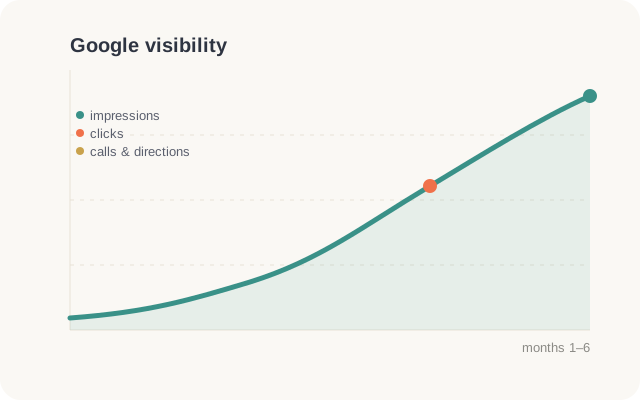
RedNote creates demand; Google catches it. A reader saves your note on Tuesday, then searches your business name on Google Maps on Saturday to check hours and directions — and the broader numbers say that final step matters: 46% of Google searches carry local intent, and 76% of people who search nearby on their phone visit a business within 24 hours. If the note is brilliant but your Business Profile shows wrong hours and three photos, the campaign leaks customers at the very last step.
So before any creator campaign goes live, run the basics: Business Profile claimed and current, bilingual website loading fast on phones, review replies active. Our local SEO checklist covers all of it — that way the RedNote spike lands on a foundation built to convert it.
Your first 30 days on RedNote
Here is the sequence we run for new clients. It is deliberately boring — RedNote marketing rewards consistency over cleverness.
If you want the shortcut, this is the exact work our RedNote team does for New York restaurants and local businesses — shoots, notes, creator collabs, and pool-level analytics included, backed by years of experience marketing 100+ local businesses and a 500+ signed creator network. Email contact@wintrabiz.com and you will hear back within 6 hours. Either way, start now: the channel will not stay underpriced forever.
- Week 1: set up a business account with a bilingual profile, location, and clear category positioning
- Weeks 1–4: publish 8–12 notes — covers and title hooks polished, keywords placed in title, body, and tags
- Weeks 2–4: book 2–3 creator store visits to seed search results for your business name and neighborhood
- Every day: reply to every comment — comments count ×4, and your replies are read by everyone who finds the note later
- Every week: track saves and comments per note, not likes, and note which pool each note reached before making the next one