Why local SEO still wins for small businesses
When someone in Queens types “dentist near me” or “flushing hair salon,” Google shows a map pack and a page of local results before anything else. Local SEO for small business is simply the work of earning those spots — without paying for every single click the way you do with ads.
The intent behind those searches is what makes this list worth a weekend: 46% of Google searches carry local intent, and Google's research shows 76% of people who search for something nearby on their phone visit a business within 24 hours. Local SEO means being present at the exact moment a neighbor is ready to buy.
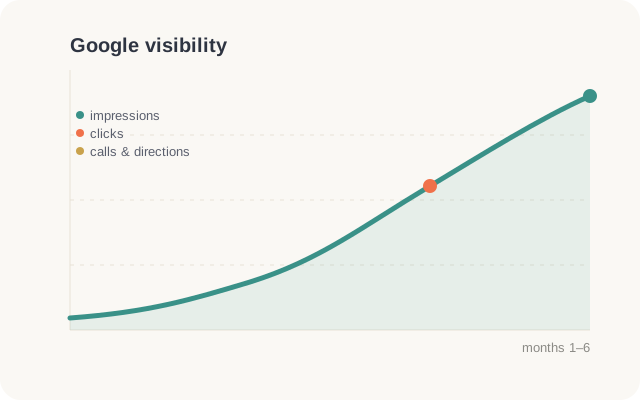
The payoff is real. One client of ours pulled 2.35K Google clicks and 39.3K impressions in a single 28-day window from local search alone. This local SEO checklist covers the same fundamentals we used to get there: Google Business Profile, on-site signals, reviews, citations, and content. Work top to bottom.
Google Business Profile (points 1–5)
Your Google Business Profile is the single highest-leverage asset in local SEO. It decides whether you appear in the map pack at all — start here before touching your website.
- 1. Claim and verify your profile at google.com/business. Use your real-world business name exactly — no keywords stuffed into the name, which risks suspension. Video verification is now the most common method, so have your storefront and signage ready to film.
- 2. Choose the most specific primary category available — “Sichuan restaurant” beats “Chinese restaurant” beats “Restaurant.” Add secondary categories only for services you genuinely offer.
- 3. Upload at least 10 real photos: storefront from the street, interior, team, and your best work or dishes. Add a few new ones every month — recency matters.
- 4. Publish a Google post every week — an offer, an event, a finished project. Posts fade from view in about a week, so a steady cadence beats occasional bursts.
- 5. Seed the Q&A section yourself. Ask and answer the five questions customers always have: parking, reservations, languages spoken, payment, insurance.
On-site SEO (points 6–10)
Your website confirms to Google where you are and what you do. These five fixes cover the on-site half of local SEO for small business.
- 6. Write title tags that pair service with city — “Emergency Plumber in Astoria, NY | Your Business Name.” One page, one service, one title.
- 7. Add LocalBusiness schema in JSON-LD — name, address, phone, hours, and geo coordinates — then run it through Google's Rich Results Test.
- 8. Keep your NAP — name, address, phone — character-for-character identical across your site footer, Google Business Profile, and every directory.
- 9. Build a location page for each area you actually serve, written with real neighborhood detail — not the same page with the city name swapped.
- 10. Pass the mobile speed test. Most local searches happen on phones; compress images and aim for a Largest Contentful Paint under 2.5 seconds.
Reviews (points 11–13)
Reviews pull double duty: they influence rankings, and they close the sale once a customer is looking at three options side by side.
A benchmark from our own shop: Wintra's profile holds a 5.0 rating across 100+ businesses served, built with the same three habits below — no filtering, no gating, just a systematic ask at the right moment.
- 11. Build steady review velocity. A few new reviews every month beats fifty in one week followed by silence. Ask at the moment the customer is happiest — right after the job or the meal.
- 12. Respond to every review within 48 hours. Thank the reviewer, mention the service and neighborhood naturally, and handle negative reviews calmly with facts.
- 13. Make asking effortless — a QR code at the counter or a text message with a direct review link. Friction is the only reason happy customers do not review.
Citations and directories (points 14–17)
A citation is any listing of your name, address, and phone on another site. Consistent citations tell Google your business data can be trusted.
How many do you need? For most neighborhoods, the core four — Google, Yelp, Apple, Bing — plus a handful of genuinely relevant directories (your chamber of commerce, industry associations, community sites) beat 200 spammy submissions from a $99 “citation blast.” Quality and consistency outrank volume here.
- 14. Claim your Yelp listing and complete it fully — Yelp data still feeds other platforms, and an unclaimed page with wrong hours costs you customers.
- 15. Register with Apple Business Connect so you appear correctly in Apple Maps — the default map for every iPhone user who asks Siri for directions.
- 16. Claim Bing Places. You can import your Google Business Profile in minutes, and Bing powers results for a meaningful slice of desktop searchers.
- 17. Audit your existing citations. Search your business name plus old phone numbers or addresses, and fix or remove every outdated listing you find.
Content (points 18–21)
Content is how you win the searches your competitors never think about — the specific service-plus-neighborhood queries with buyers behind them.
- 18. Publish a page for each service-and-city combination you actually serve — “kitchen remodeling in Bayside” deserves its own page, not a bullet on your homepage.
- 19. Build an FAQ page from real customer questions: pricing, timelines, guarantees, and “do you speak Chinese?” FAQ content also earns rich results in search.
- 20. Show local proof: real photos of real jobs, neighborhood names, and landmarks your customers recognize. Stock photos convince no one.
- 21. Measure monthly with Google Search Console and GBP performance reports: calls, direction requests, and the exact queries bringing people in.
Five mistakes that undo everything above
Doing the checklist is half the job; not sabotaging it is the other half. These five mistakes appear constantly in the audits we run:
- Stuffing keywords into your business name. “Joe's Plumbing — Best Cheap Plumber Queens NYC” reads as spam to Google and is a leading cause of profile suspensions.
- Buying reviews. Purchased reviews violate Google's policies, arrive in unnatural bursts, and can take your genuine reviews down with them when the filter catches on.
- Letting hours go stale. Wrong holiday hours are the fastest source of one-star reviews — and those reviews stay long after the hours are fixed.
- Duplicating location pages. Ten pages with the same text and swapped city names help nothing and can drag the whole site down.
- Quitting at week six. The compounding phase of local SEO starts around month three; most businesses that “tried SEO and it didn't work” stopped exactly when it was starting to.
The free tools that run this checklist
Every point above can be executed with free tooling. Bookmark these six:
- Google Business Profile manager — edit your listing and see calls, direction requests, and search queries.
- Google Search Console — the queries, clicks, and impressions your site actually earns; the 2.35K clicks and 39.3K impressions cited earlier come from exactly this report.
- PageSpeed Insights — mobile speed scores with a prioritized fix list.
- Google's Rich Results Test — confirms your LocalBusiness schema is readable.
- Google Maps itself — search your own category in incognito mode to see the map pack you are trying to crack.
- A plain spreadsheet — one row per citation, one column per field. NAP consistency is a bookkeeping problem, and bookkeeping beats memory.
Your first 30 days: where to start
Do not attempt all 21 points in one weekend. Week one: knock out the Google Business Profile items (1–5) — they move the needle fastest. Week two: fix title tags and NAP consistency (6, 8). Week three: set up your review ask and claim Yelp, Apple, and Bing (11–16). Week four: outline your first two service-plus-city pages and set up Search Console (18, 21).
After the first 30 days, shift to a maintenance rhythm: one Google post and a few new photos each week, review replies within 48 hours, one new service-or-neighborhood page per month, and a monthly 15-minute look at Search Console. Local SEO rewards the steady, not the heroic — 3–6 months of this rhythm beats any one-time blitz.
Most of this checklist costs nothing but time. If you would rather spend that time running your business, a local SEO partner can run the entire list — that is exactly what our local SEO service does for New York businesses, with plans starting at $159 per month and years of experience running this exact checklist for 100+ local businesses. Email contact@wintrabiz.com and you will hear back within 6 hours.