What an SEO company actually does
Definition first: an SEO company is a firm you pay — typically $500–$5,000 per month in New York — to make your business more visible in Google's organic results and map pack. That visibility is worth paying for because 46% of Google searches carry local intent, and page-one results capture the large majority of clicks.
Strip away the jargon and a competent SEO company in New York does four things: fixes the technical health of your site (speed, mobile usability, crawlability), creates content that answers what your customers actually search, builds your local presence (Google Business Profile, reviews, citations, location pages), and earns links and mentions that build authority. Everything else — the dashboards, the audits, the buzzwords — is packaging around those four.
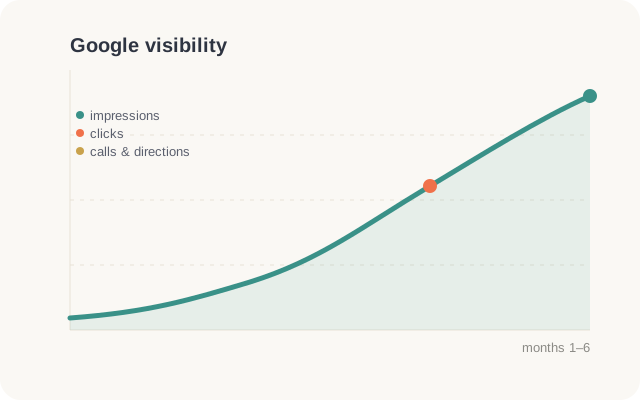
The output that matters is measurable: more impressions and clicks in Google Search Console, more calls and direction requests from your Business Profile, and ultimately more customers through the door. If a firm cannot connect its work to those numbers, it is selling activity, not results.
Full-service shops — ours included — typically offer around 8 services, from web design and local SEO to Business Profile management, reviews, content, and ads. You rarely need all 8 at once. A good firm sequences them by impact; a firm that pushes the whole bundle on day one is optimizing its invoice, not your rankings.
Agency vs. freelancer vs. in-house
The right structure depends on your budget and how competitive your market is:
- An agency gives you a team and a process — useful in competitive industries — at roughly $1,500–$5,000+ per month in New York.
- A freelancer costs less ($500–$2,000 per month) and can be excellent, but you depend entirely on one person's bandwidth and skill set.
- In-house makes sense once you spend well past $100K per year on marketing; below that, a New York SEO salary is hard to justify for one channel.
- A hybrid path also works: pay for a one-time audit and prioritized fix list, implement it with a freelancer, and revisit a monthly retainer once the basics are done. Plenty of single-location businesses never need more than that.
The evaluation criteria that actually matter
The best SEO company in New York for your business is the one that can prove its work with primary sources. Ask every candidate for three things: case studies backed by real Google Search Console data — actual clicks and impressions with dates, not “traffic up 300%” with no baseline; a written month-by-month deliverables plan, so you know what you are buying in month one versus month six; and a clear answer to who does the work, because plenty of firms sell locally and subcontract everything overseas.
Also weigh industry experience — ranking a Flushing restaurant is a different job from ranking a Midtown law firm — and communication cadence. A monthly report with a human explanation beats a weekly automated PDF nobody reads.
How to verify a case study in 15 minutes
Every agency shows case studies; few survive contact with basic checks. Before any sales call, spend 15 minutes on these five:
- Ask whether the screenshots come from Google Search Console or a third-party tool. Search Console shows real clicks from Google; third-party “visibility scores” are estimates that can be cherry-picked.
- Check the dates. A chart with no time axis, or one that conveniently starts at zero right after a site migration, is decoration rather than evidence.
- Search the client's core keyword yourself, right now, in an incognito window. Either the business appears or it does not.
- Ask how long the result took. Honest answers sound like 3–6 months of early movement and 6–12 months of compounding — not 30 days.
- Ask to speak to the client. Agencies with real results have clients happy to take a five-minute reference call.
The guarantee test: anyone promising #1 is lying
This is the fastest filter in the industry. No one controls Google's rankings — not the biggest agency in Manhattan, not a “Google Partner,” no one. Google itself explicitly warns businesses against firms that claim guaranteed rankings or special relationships with the search team, because no such relationship exists. Rankings depend on your competitors, on algorithm updates, and on your market.
A trustworthy firm commits to specific work and honest reporting, never to positions. When you hear “guaranteed page one in 30 days,” the guarantee is either a lie or a keyword nobody searches for. Either way, end the meeting.
The same filter now applies to firms promising “guaranteed AI visibility” or fixed lead counts. New packaging, same trick: whenever a vendor claims control over a system Google runs, walk.
What SEO costs in New York
Monthly retainers are the standard model, and the ranges are fairly consistent across the city:
Contract terms matter as much as the number. Month-to-month after an initial 3-month commitment is fair on both sides; a 12-month lock-in with auto-renewal mostly protects the agency, not you.
- $500–$1,500/month — local SEO for a single-location business: Business Profile management, reviews, on-page fixes, local content.
- $1,500–$3,000/month — competitive local markets or multi-location businesses: everything above plus ongoing content and link building.
- $3,000–$5,000+/month — citywide or national campaigns in tough verticals like legal, medical, or real estate.
- One-time audits and cleanup projects typically run $1,000–$5,000 and are a sensible low-commitment starting point.
What the first 90 days should look like
SEO takes 3–6 months to show compounding results, but the work itself should be visible from week one. Here is a reasonable baseline to hold any firm to — and if a proposal cannot be broken into a schedule like this, you are not buying a program, you are buying a subscription to hope:
- Month 1 — foundation: a full technical audit, Search Console and analytics access confirmed inside your own accounts, keyword research mapped to your actual services, a Google Business Profile review, and a fix list with owners and dates.
- Month 2 — execution: technical fixes shipped, title tags and on-page work live, the first content pieces published, citations corrected, and a review-generation process running.
- Month 3 — measurement: a report comparing clicks and impressions against the month-one baseline, ranking movement on the mapped keywords, and next quarter's plan adjusted by what the data shows.
Local SEO vs. national SEO — know which one you need
If your customers walk through a door — a restaurant in Queens, a clinic in Brooklyn, a salon in Manhattan — local SEO comes first: the map pack, your Google Business Profile, reviews, and neighborhood pages. It usually moves faster and pays back sooner than broad organic rankings. National SEO is a content-and-links volume game for businesses that sell everywhere, and it costs accordingly. Be wary of a firm that pitches a national-scale program to a single-location storefront; that mismatch is one of the most common ways New York businesses overpay.
The local numbers explain why. Google's research shows 76% of people who search for something nearby on their phone visit a business within 24 hours. For a storefront, winning the map pack is not a branding exercise — it is same-week revenue.
Questions to ask before you sign
Put these in an email and keep the answers with the contract:
- Can I see Search Console data from a current client, with their permission?
- Exactly what will you deliver in months one, two, and three?
- Who owns the content, the links, and my analytics accounts?
- What happens if I cancel — is there a lock-in period or a handover process?
- Have you ranked a business in my industry or my borough before?
- Will you report raw Search Console numbers, or only a dashboard you control?
What transparent reporting looks like: a real example
At Wintra, we show prospects the same numbers we show clients. One local client's site drew 2.35K Google clicks and 39.3K impressions in 28 days, and their Business Profile logged 141K views and appeared in 88K Google searches over six months — pulled straight from Search Console and Google's own dashboards, not from a marketing deck.
Behind those charts are years of experience running this exact playbook for 100+ local businesses, with monthly plans from $159 and every inquiry answered within 6 hours. We are not the right fit for everyone, but this is the standard of evidence you should demand from whoever you hire. If you want a second opinion on a proposal you have received, email contact@wintrabiz.com — we will read it with you.